Year: 2016
Made with: Rhinoceros, Grasshopper, Unity, Photoshop, Illustrator, Vray
Third year urban studio project.
Instructor: Dr. Arch. Efrat Blumenfeld-Lieberthal
Team: Noy Ilan, Asaf Jan, Shani Alezra, Julia Barashkova
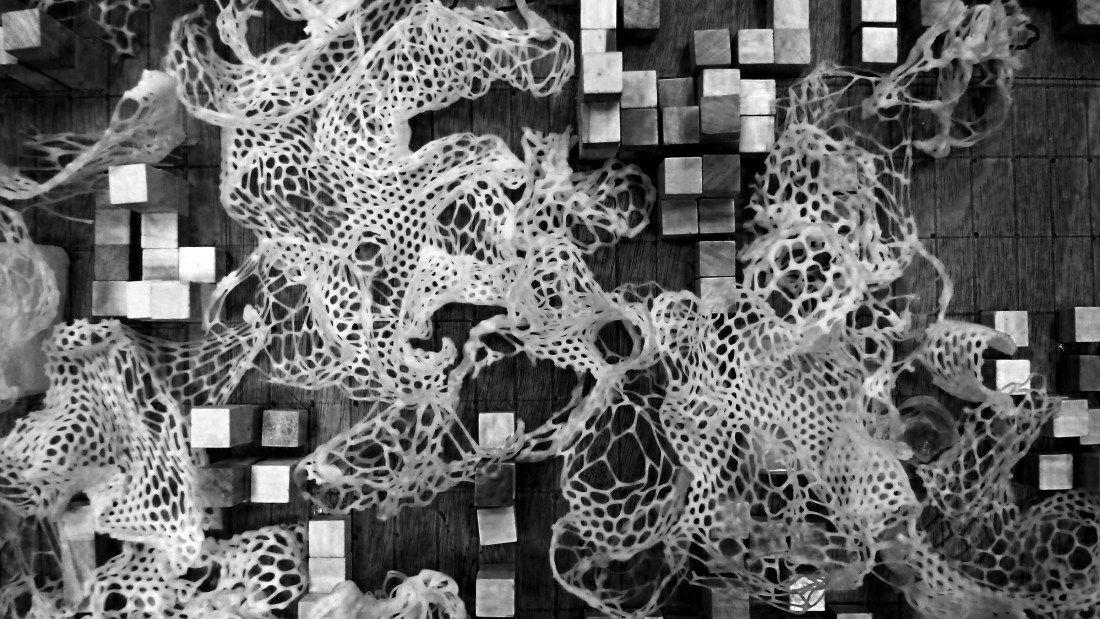
This project is about understanding how human needs and desires affect our spatial interactions (in urban scale). Specifically, how allowing these natural interactions to singly design space lead, in time, to the creation of cities, neighborhoods, zoned areas, roads and streets, where people can fulfill their wills without the intervention of any authority and without a pinch of top-down urban planning.
Economy of Anarchy
The year is 2070. It’s been two decades since the information revolution has finally come to its peak, unifying all physical currencies to Material and all virtual currencies to Knowledge. Technology has made it to the point where people can change and reshape their surrounding in a click of a button, within the limits of their owned real and digital resources. This erased the definition of place and the abillity to control spaces, and lead to the collapse of every ruling system.
New New York is an ever changing spatial composite of two different ideologies: The People, who wants to bring the government back and handle their interactions through enforcing laws and bureaucracy, and Individuals, who handle their interactions with peer-to-peer contracts executed by technology, such as “We do not block each other’s entrances or agreed paths”.
To maintain the old conventions, The People stock up material and keep their space in order, preserving their culture, their iconic places and reconstructing the Manhattan grid. Individuals are self-organized. To maintain his wills, each individual have to constantly get information and knowledge as the space is always changing by others.
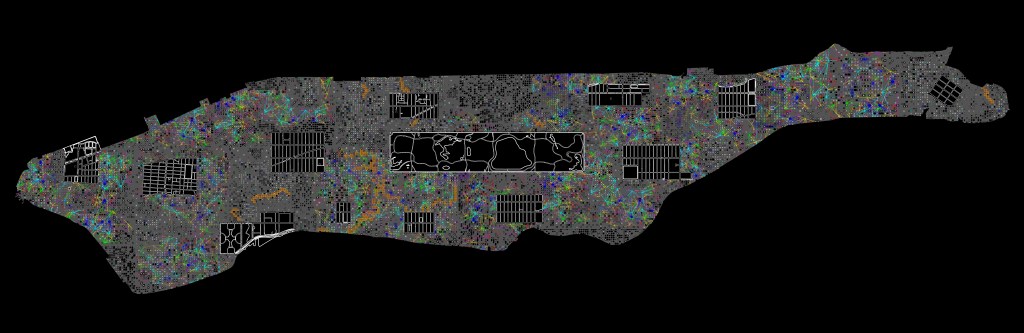
New New York Map
Events and Neighborhoods
As we’re already familiar with The People’s democratic cities, we will continue investigating the Individuals anarchy areas.
Individuals cannot create places. Their agreements are based on their own will to do different activities, which are temporary, so they create events in space.
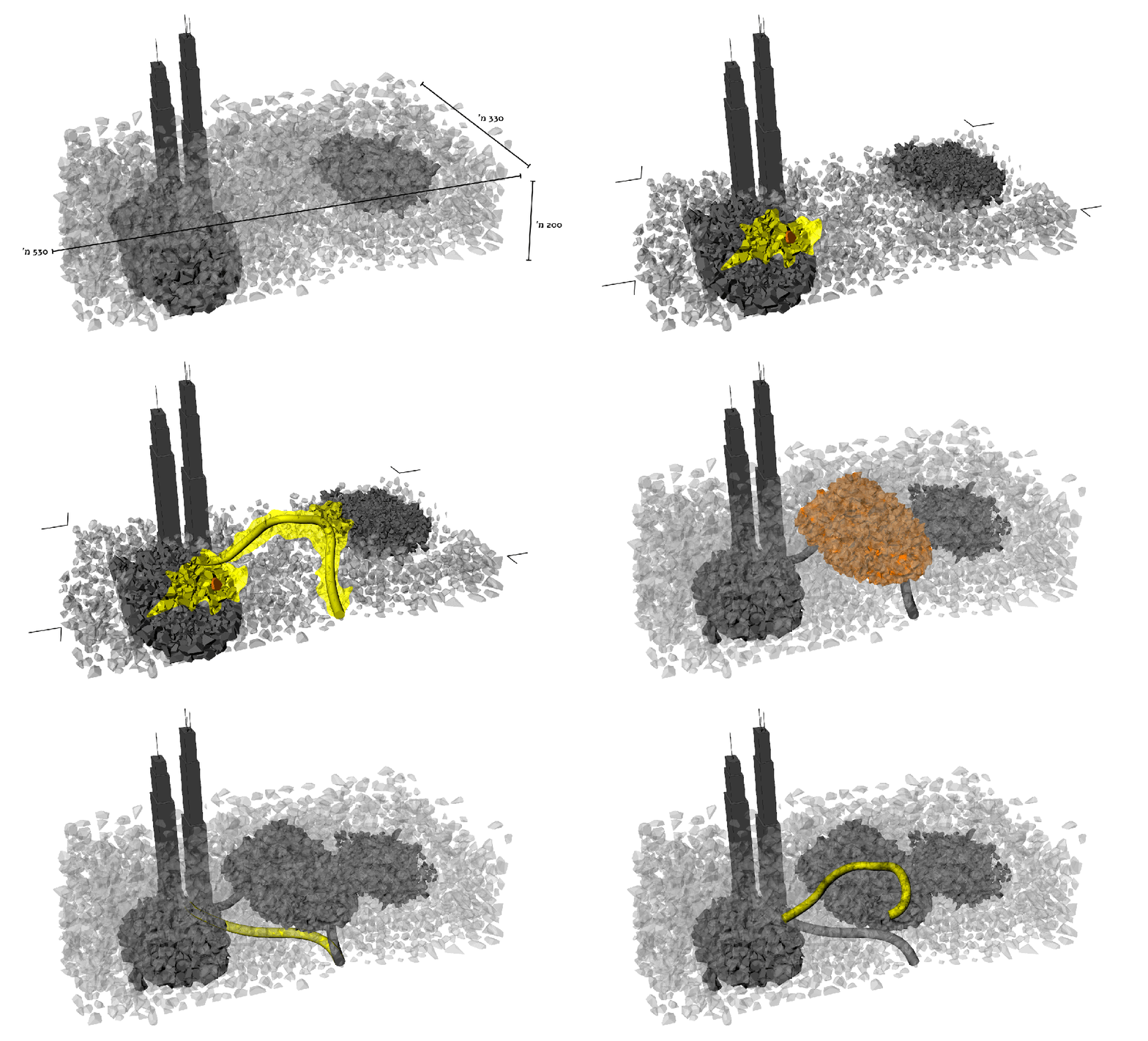
To understand how are these events formed and in what form, we simulate the current situation with generalized random wills (needs and desires) and resources (information, rapidity and material). Given the New New York map with its very dense population, imported food stores on island edges and impenetrable static The People areas, individuals start to connect with others that hold similar desires and with food stores, creating events. Their migration choices are affected by these connections and by the density of the way to each event.
The following video shows how the above conditions cause individuals to conglomerate and create neighborhoods based on common needs and desires:
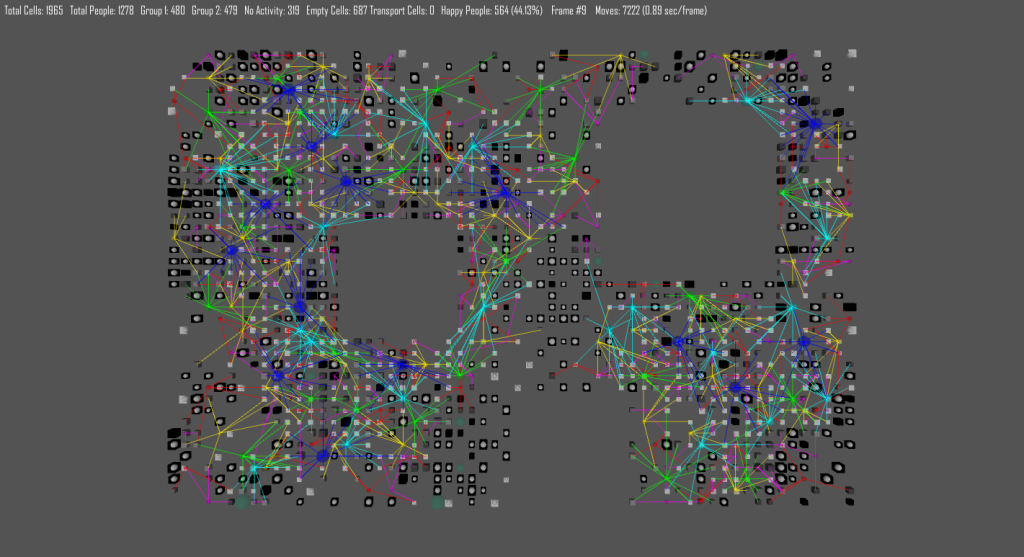
Migration Simulation 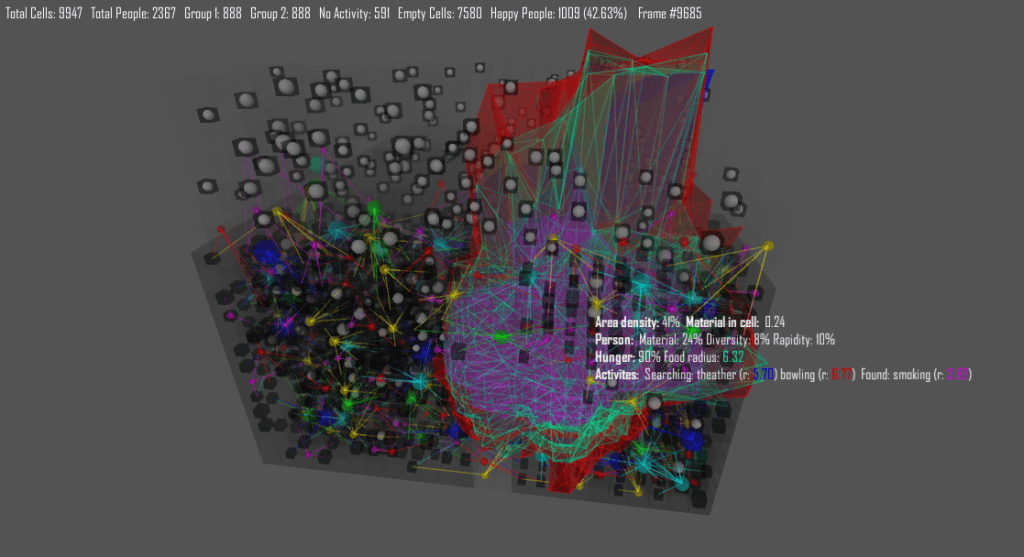
3d Simulation
Roads and Streets
As space is changing at the same speed that people move, the way from one position to another is not measured by distance, but by time, which is precalculated from distance and density, according to known agreements. An individual’s abillity to travel longer is dependent on its resources, so there are individuals who get stuck in the middle of a dense conglomeration and cannot fulfil their wills.
To help these unhappy individuals, we bring an old idea to the simulation: A person or a company who have enough resources will occupy and make a permanent linear path, defined by minimum material per travel-distance, renting others the right to pass through this road.
The following video shows how a creation of one road between two neighborhoods can help individuals find more connections, move longer and fulfil their wills:
As seen at the end of the above video, when the system is stabillized, the road becomes unnecessary due to low-resourced individuals migration from its ends to its middle. When that happens, the road is not profitable and its owners would do one of two things: take the material and build a more profitable road, or repurpose the road and rent its space for different events and gatherings, making it a street.
Land Use
The street make a regulated island in an unregulated environment, so its owners can use it to bring some of The People’s urban typologies to the anarchy: parks, squares and passages. Such public areas require a high level of control on a large space, or a consensus regarding its usage, both are rare in the individuals territories.
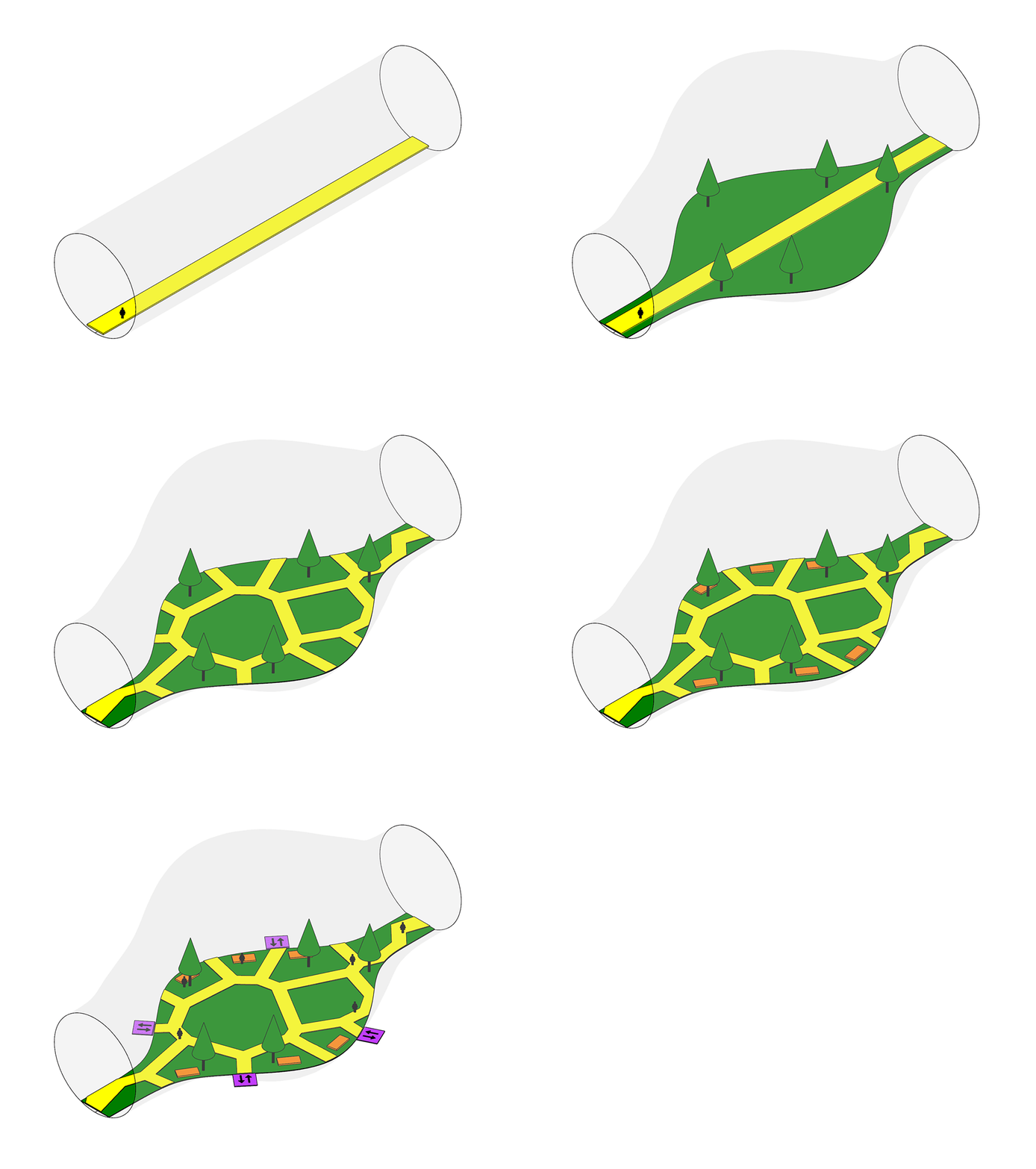
Central Park 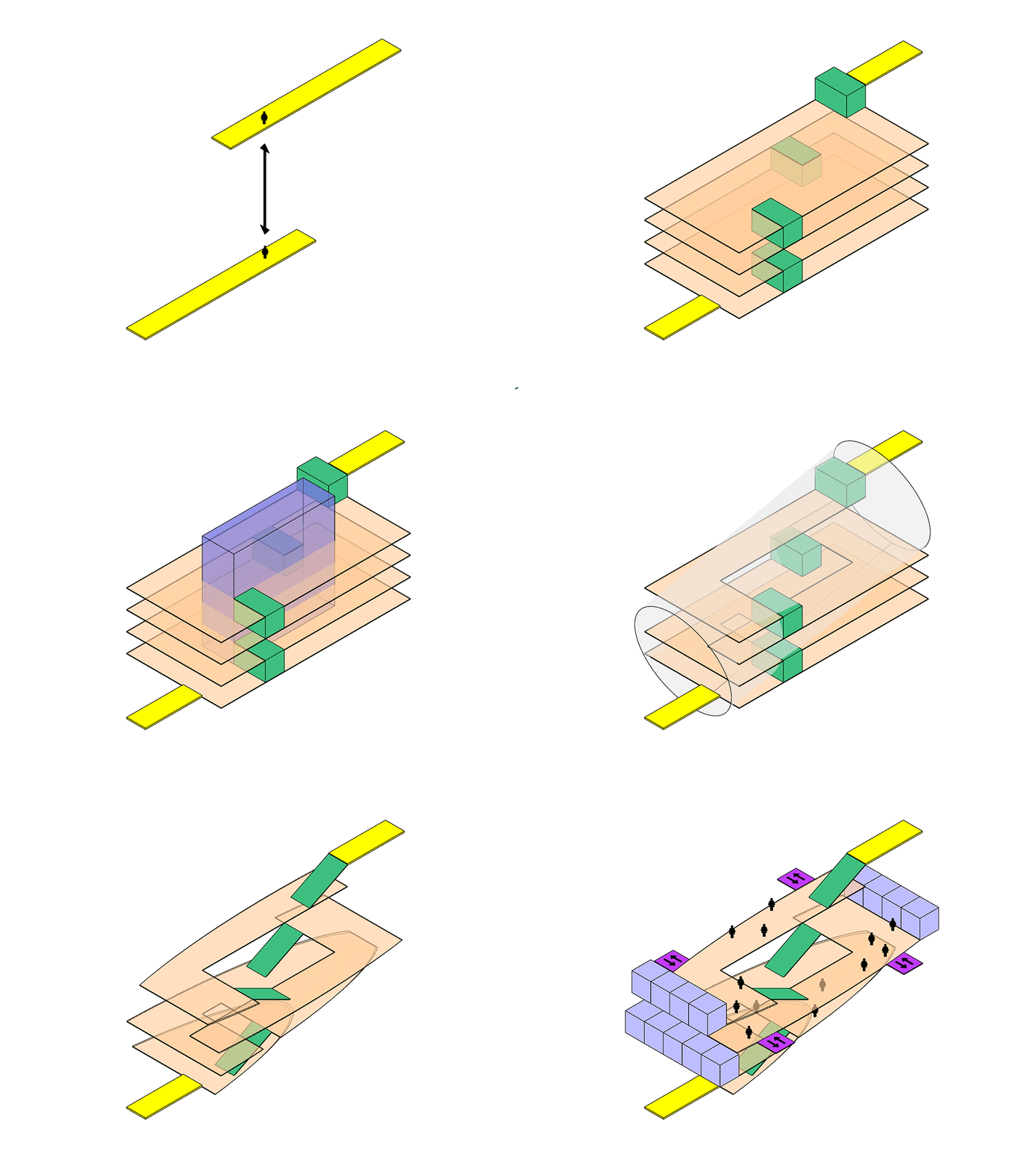
Public Square 
Street Passage
Even though a street is a constant place with defined and concrete spaces, its uses does not have to be constant. To utilize space effectively, the street owners can keep a scheduled land-use system which will respond to renters’ wills.

planned and random meetings 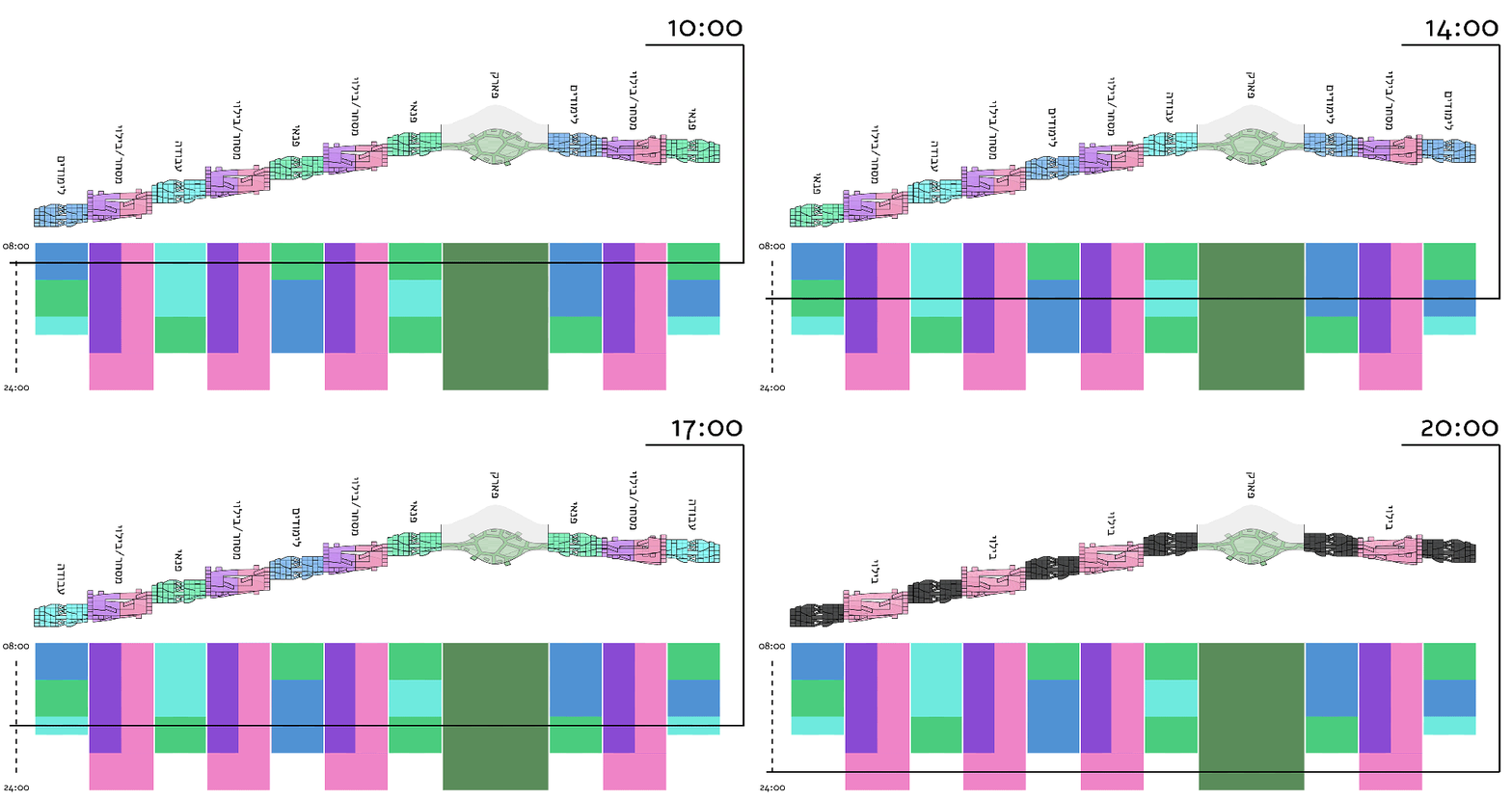
Scheduled land uses
The following video shows a fictional frozen state of a street, previously built as a 3d tunnel road with the logic explained above, waiting for a linear path to emerge between other properties, then repurposed by its owners to contain different usages, including a central park, multilevel public squares, grid-like sidewalk system, stores, offices and many other spaces:
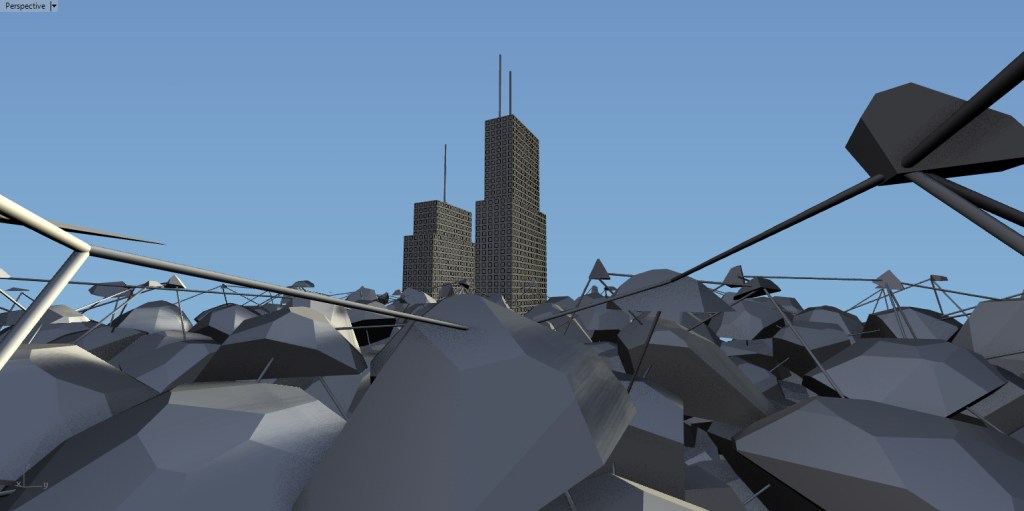
“Rooftop” 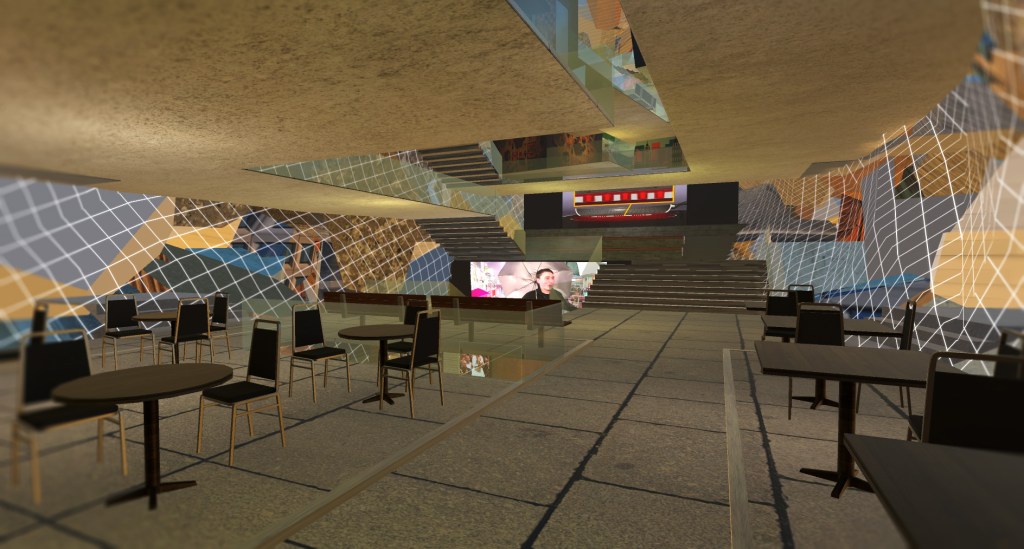
Multilevel Square 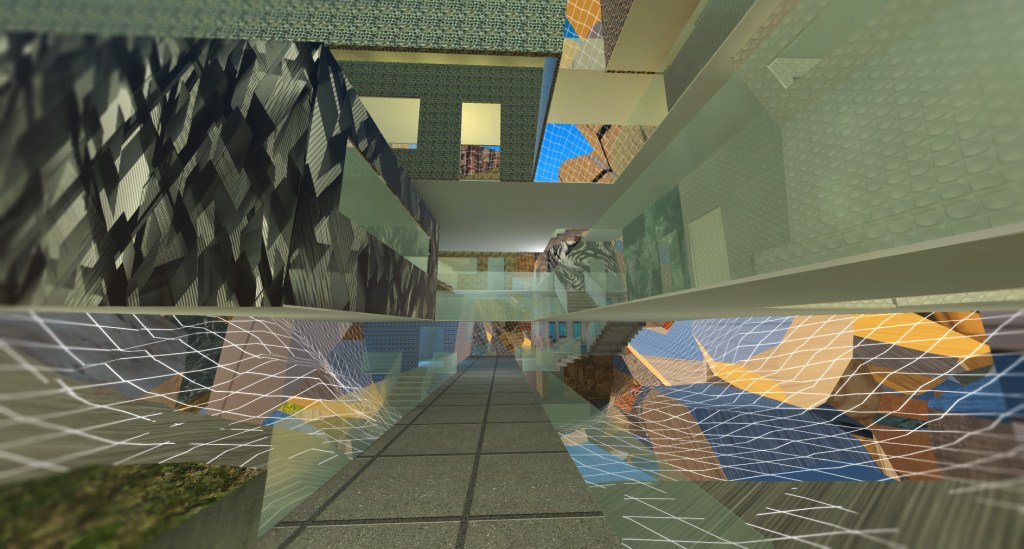
Street Passage 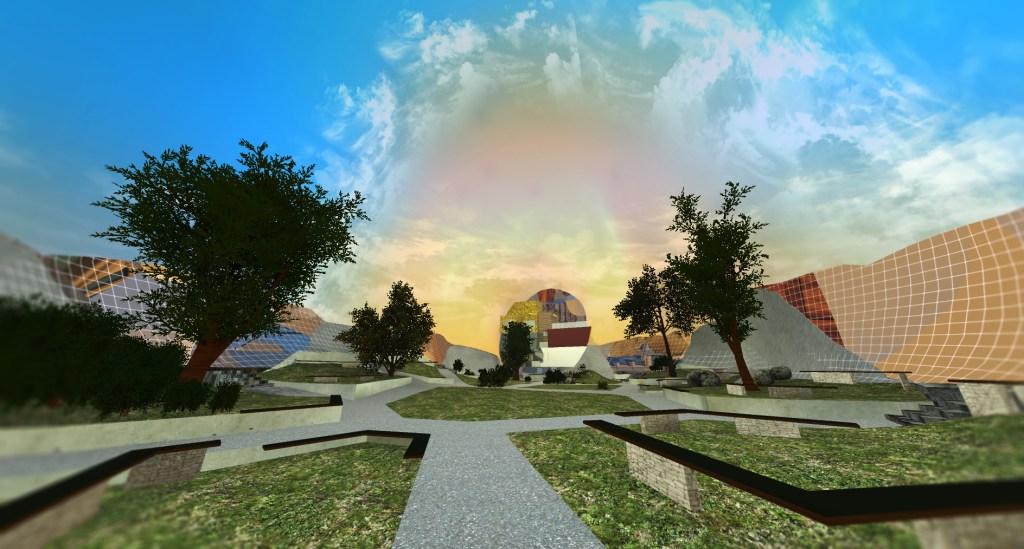
Street Central Park 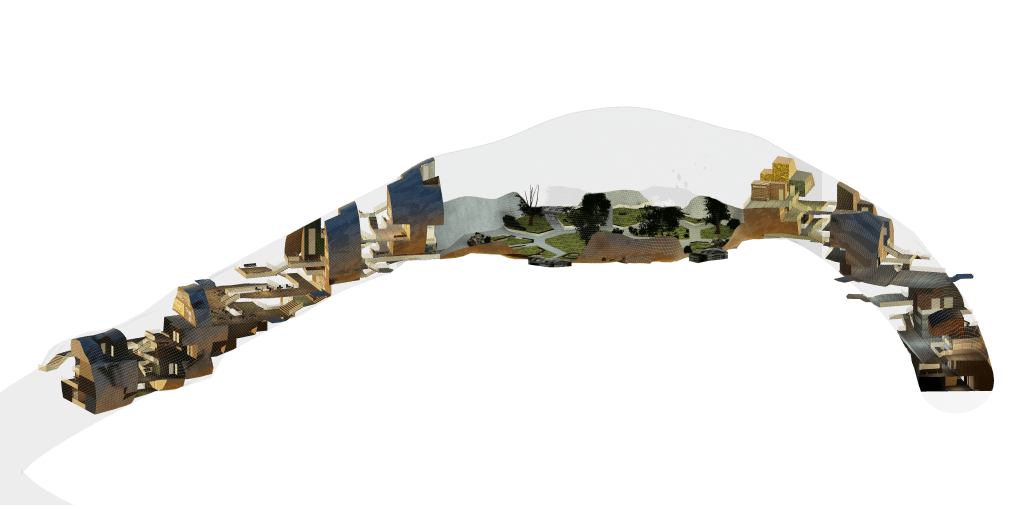
Street Side View
The above street marks the creation of a large-scale ruling system in an anarchy. The dependency of a growing individual society on such spaces is what make a ruling system grow and become a bureaucracy, chaining new individuals to each other with old contracts, establishing the foundations of a municipality and a government.
 Noyil
Noyil 